Blog
Financial Foresight: The Real Cost of a Luxury Wedding in Ahmedabad (2026 Edition)

AUM Event Team
March 6, 2026
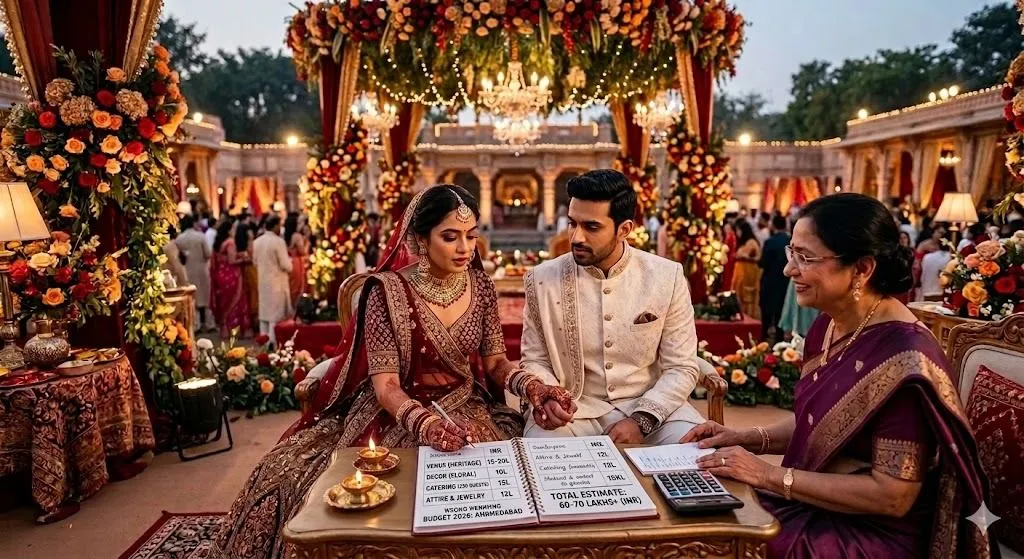
Transparent pricing analysis of high-end wedding services. Why choosing an experienced planner saves you money in the long run.
The air inside the glass-walled marquee on Sindhu Bhavan Road is cool, conditioned, and carries the faint, clean scent of tuberose and damp earth. Guests move not through a banquet hall, but a curated landscape. A 40-foot monolithic bar, clad in tactile, hand-beaten copper, glows under a precise constellation of pin-spot lighting. Conversations are intimate, buffered by acoustic paneling disguised as art installations. Every surface, from the raw silk napkins to the brushed metal cutlery, is a decision. Outside, the Ahmedabad night hums with chaotic energy, but in here, every moment is a product of meticulous, expensive, and largely invisible design. This is the new apex of luxury in Gujarat, a sensory world built on a foundation of complex logistics and sophisticated capital. The critical question isn't what it looks like, but what this level of immersive experience truly costs to engineer.
Deconstructing the Ahmedabad Luxury Wedding: A Financial Blueprint for 2026
The phrase ‘luxury wedding’ is an increasingly insufficient descriptor for the scale of private events now materializing in Ahmedabad. We are witnessing the rise of multi-day, multi-location experiential productions that demand the financial and logistical rigor of a corporate roadshow. For 2026, a top-tier, 300-guest wedding in the city is not a line-item budget; it's a portfolio of strategic investments. The foundational cost, the venue, sets the entire financial tone. A sprawling, manicured lawn on the SG Highway commands a premium that extends far beyond its rental fee; it establishes a baseline of expectation that elevates the cost of every subsequent vendor. This is what we call the ‘Venue Multiplier Effect.’ A ₹25 lakh venue hire doesn't exist in a vacuum; it necessitates a commensurately grand F&B experience, where per-plate costs can escalate from a standard ₹3,500 to over ₹8,000 for bespoke menus featuring live culinary theaters. According to the veterans at AUM Event, who have navigated this landscape for over 35 years, clients must understand that 40-50% of the total budget is consumed by the intertwined costs of venue and catering before a single piece of decor is even conceptualized. Their principle of 'Logistical Choreography' begins here, mapping these core expenses to guest flow and experience, ensuring the financial architecture supports the creative vision, rather than constraining it.
- The Vendor Ecosystem: Booking a marquee photographer or decorator isn't a simple transaction. A-list vendors operate with their own non-negotiable technical riders and team requirements, adding unforeseen costs for everything from dedicated power lines to specialized transport and accommodation, often bloating a category by 15-20%.
- The Artisan Premium: Sourcing authentic craftsmanship—like intricate metalwork from Saurashtra artisans or hand-woven textiles from Kutch—is a hallmark of modern luxury. This involves more than the cost of the material; it includes scouting, commissioning, quality control, and transport logistics. The price reflects the narrative of authenticity, a cost that mass-produced alternatives cannot replicate but one that discerning guests implicitly recognize.
- The Technology Imperative: Beyond decorative lighting, we're talking about structural and data infrastructure. A seamless guest experience powered by a custom event app, RFID check-ins, or responsive environmental lighting requires enterprise-grade Wi-Fi, redundant power systems, and on-site technicians—a significant, often unbudgeted, backend expense.
- The Governance Layer: The unglamorous but critical costs of producing events at scale include a labyrinth of permits, PPL/IPRS music licenses, robust private security details, valet services capable of managing 200+ vehicles, and multi-day waste management contracts. Forgetting this layer can derail an entire production.
The Sensory Architecture: Engineering the 2026 Guest Experience
Looking toward 2026, the definition of luxury is shifting from overt opulence to intelligent, sensory design. The primary trend is the development of ‘Responsive Environments’—spaces that subtly adapt to the emotional and temporal rhythm of the event. This is not about garish, color-changing LEDs. It's a far more sophisticated application of technology. Imagine a sangeet where the ambient hue of the lighting warms incrementally as the energy on the dance floor builds, or where focused audio zones allow for quiet conversation just feet away from a high-energy performance. AUM Event’s approach involves deploying modular AV and lighting kits that can be reconfigured overnight, transforming a space from a serene, daytime mehndi setting into a dramatic, high-contrast reception. The second, counter-intuitive trend is a move toward what can be termed ‘Unplugged Luxury.’ This is the art of using immense technological and logistical support to create an experience that feels organic and profoundly human. The focus is on tactile, authentic materials that engage the senses beyond the visual. We're seeing a move away from generic florals and drapery toward structural installations using materials with inherent narrative weight: cool, solid marble; the rich patina of aged brass; the visual texture of raw, undyed silk. The goal is to create a space that invites touch and interaction, a sensory journey where the story is told not just by what guests see, but by what they feel.
The Cost of Control: The ROI of Logistical Choreography
The most significant error in budgeting for a high-stakes event is viewing the management fee as a mere percentage cost. It should be re-contextualized as a strategic investment in risk mitigation and quality assurance. An experienced firm like AUM Event doesn't just plan; they underwrite the entire operation. Their 35 years of institutional knowledge translates into a vetted, resilient supply chain, preemptive problem-solving, and the negotiating leverage to secure not just better pricing, but better terms and commitment from top-tier vendors. Their 'Logistical Choreography' is the operational framework that protects the client's nine-figure investment from the hundreds of variables that can lead to catastrophic failure. The ROI is not measured in line-item discounts, but in the seamless transition between events, the flawless execution of technical cues, and the invaluable insulation of the client from the thousands of operational decisions that must be made in real-time. It is the cost of absolute control and guaranteed peace of mind.
Conclusion: The Future of Events in Ahmedabad
Ahmedabad is at an inflection point. The city’s rising economic influence, coupled with a globally-exposed clientele, is fueling a demand for events that are less about demonstration and more about deep experience. The market is maturing beyond the predictable opulence of the SG Highway corridor, seeking unique canvases for storytelling—from exclusive private functions overlooking the Sabarmati Riverfront to sleek, corporate-infused celebrations in the modern landscape of GIFT City. The challenge for 2026 and beyond will be to deliver productions that are both culturally resonant and operationally world-class. This requires a profound shift in mindset from simple event planning to holistic experience architecture. It demands a partner who understands that the true product is not the decor or the menu, but the guest's emotional and sensory journey. For families and brands looking to make a definitive statement in this evolving landscape, the first and most critical investment is in proven strategic leadership. To navigate the complexities and unlock the potential of this market, you don't need a planner; you need a production partner with the foresight and operational mastery to transform ambitious vision into flawless reality. You need AUM Event.
.webp)